
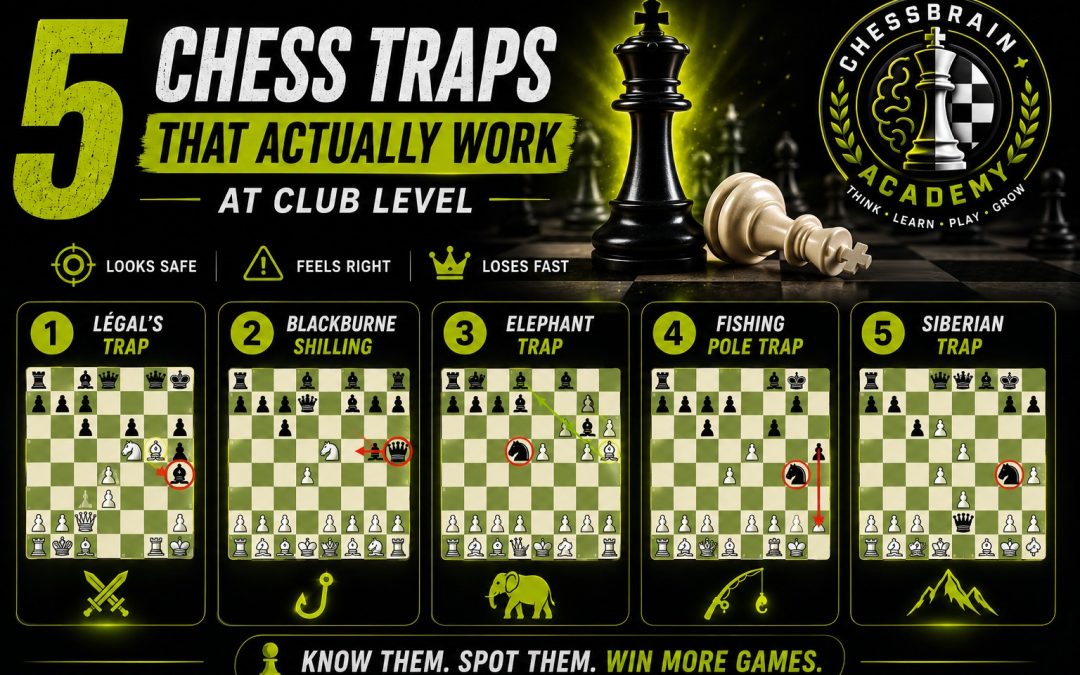
5 Chess Traps That Actually Work at Club Level
Chess traps get a mixed reputation. Purists will tell you they're "unsound" and that a well-prepared opponent should never fall for them. That's true — at the grandmaster level. But most of us aren't playing grandmasters.
We're playing club players, weekend tournament regulars, and friends across a coffee shop table, and at that level, a good trap wins games constantly, because the "refutation" requires spotting a quiet, non-obvious move under pressure.
Here are five traps with a long track record of catching real opponents in real games — what they look like, why they work, and how to avoid the embarrassment of falling into one yourself.
1. Légal's Trap (Légal's Mate)
The setup: 1.e4 e5 2.Nf3 d6 3.Bc4 Bg4 4.Nc3 g6 5.Nxe5!
This is the granddaddy of all chess traps, dating back to the 1700s and the French master Sire de Légal. Black has just pinned White's knight on f3 to the queen with ...Bg4, and it looks like the knight can't move. White ignores the "pin" entirely and grabs the e5 pawn.
Why it works: If Black greedily grabs the queen with 5...Bxd1??, White has a forced mate: 6.Bxf7+ Ke7 7.Nd5#. The king gets checkmated by a bishop and two knights working together — White happily gives up the queen because the mate is worth far more.
The lesson: A pin on a knight only matters if the knight actually needs to stay put. Here, the "pinned" knight had somewhere much more important to be. If you're Black, the way to sidestep this entirely is simply not grabbing the queen — 5...Nxe5 keeps things level.
2. The Blackburne Shilling Gambit
The setup: 1.e4 e5 2.Nf3 Nc6 3.Bc4 Nd4!?
Black's third move looks like a beginner's mistake — the knight does nothing and can be kicked around. Many players can't resist grabbing a "free" pawn with 4.Nxe5??
Why it works: After 4.Nxe5?? Qg5!, Black's queen attacks both the knight on e5 and the pawn on g2 at the same time. If White greedily grabs the rook with 5.Nxf7??, Black plays 5...Qxg2 6.Rf1 Qxe4+ 7.Be2 Nf3#, a beautiful smothered checkmate.
The lesson: Not every "free" pawn is actually free, and double attacks born from an opponent's seemingly bad move should raise a flag rather than get ignored. If you're White, the trap is easily dodged with 4.Nxd4 or 4.c3 instead of grabbing the e5 pawn.
3. The Elephant Trap (Queen's Gambit Declined)
The setup: 1.d4 d5 2.c4 e6 3.Nc3 Nf6 4.Bg5 Nbd7 5.cxd5 exd5 6.Nxd5??
This one is a favorite because it looks so safe. White's bishop on g5 appears to pin Black's knight on f6 to the queen on d8, so when White grabs the pawn on d5, it looks like Black can't recapture with the knight.
Why it works: The pin is an illusion. Black plays 6...Nxd5! anyway, and if White grabs the queen with 7.Bxd8??, Black replies 7...Bb4+, a check that White can only block with 8.Qd2. Then 8...Bxd2+ 9.Kxd2 Kxd8 leaves Black a full minor piece ahead.
The lesson: Just like in Légal's Trap, a "pin" isn't real if the pinned piece has a more urgent job — here, recapturing a piece and delivering check outranks staying put to guard the queen. This is an extremely common trap at the 1200–1600 level, so if you play the Queen's Gambit Declined as White, drill the correct move order until 6.Nxd5 simply never occurs to you.
4. The Fishing Pole Trap (Ruy Lopez)
The setup: 1.e4 e5 2.Nf3 Nc6 3.Bb5 Nf6 4.O-O Ng4!? 5.h3 h5!
This one is pure psychology. Black plants a knight on g4 for no apparent reason. White naturally kicks it with h3, expecting the knight to retreat. Instead, Black doubles down with ...h5, offering the knight as bait.
Why it works: If White greedily grabs the knight with 6.hxg4??, Black recaptures with 6...hxg4, and suddenly the h-file is a loaded cannon pointed straight at